
Every risk scored, every device flagged, one register
Organisation-level risks scored by likelihood and impact, plus per-device flags for warranty, RAM, OS, disk and CPU, instead of scattered across a spreadsheet and one engineer's memory.
Risk tracking that lives in one engineer's head doesn't survive staff turnover
Most MSPs know a client's biggest risks, informally. It's in an engineer's notes, a stale spreadsheet, or last quarter's assessment. When that person leaves, or the review comes round, the risk position has to be reconstructed from scratch, and nothing proves it was ever tracked at all.
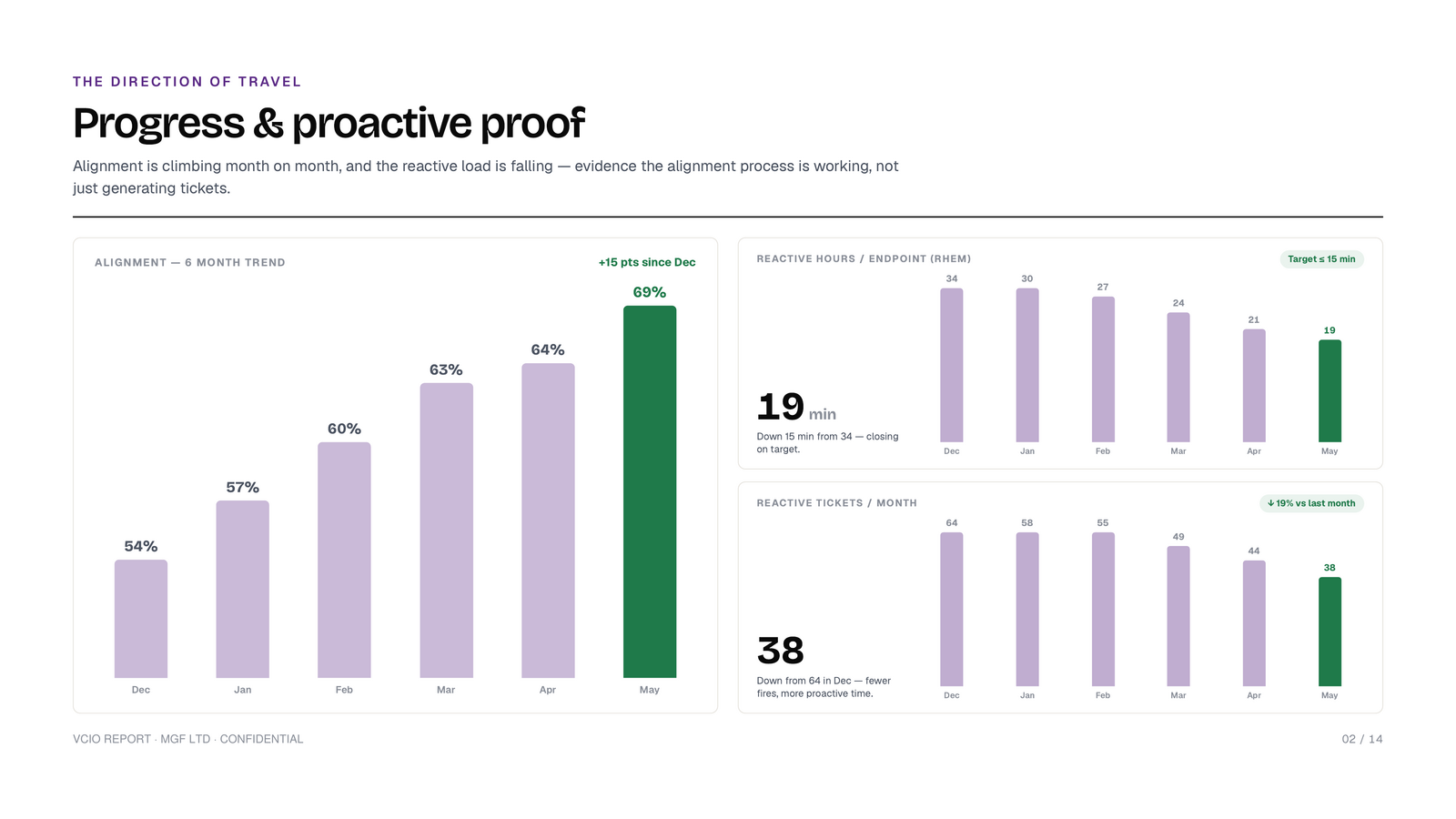
Example output from a demo account, not a real customer's data.
Every risk scored the same way, every time
Risks are logged against likelihood and impact (each 1-5), giving an overall severity score out of 25. Categorised by type (security, continuity, infrastructure, identity, process) so patterns show up across your whole client base, not just one site.
- Likelihood × impact scoring, ranked highest severity first
- Categorised by risk type for cross-client comparison
- Status tracked through to Open, In progress, or Accepted
- Full history retained: what was found, when, and what was done about it
Example output from a demo account, not a real customer's data.
Individual devices get flagged too, not just the organisation
Every device carries its own flags (out of warranty, under-spec RAM, unsupported OS, failing disk, ageing CPU) with the reason spelled out in plain English. A device can carry more than one flag, and high-severity ones surface first.
- Flags for warranty, RAM, OS, lifecycle age, disk health and CPU
- Each flag explained: not just a red icon, a reason a client will understand
- Ranked by severity so the conversation starts with what matters most
- Feeds directly into the hardware replacement roadmap and budget
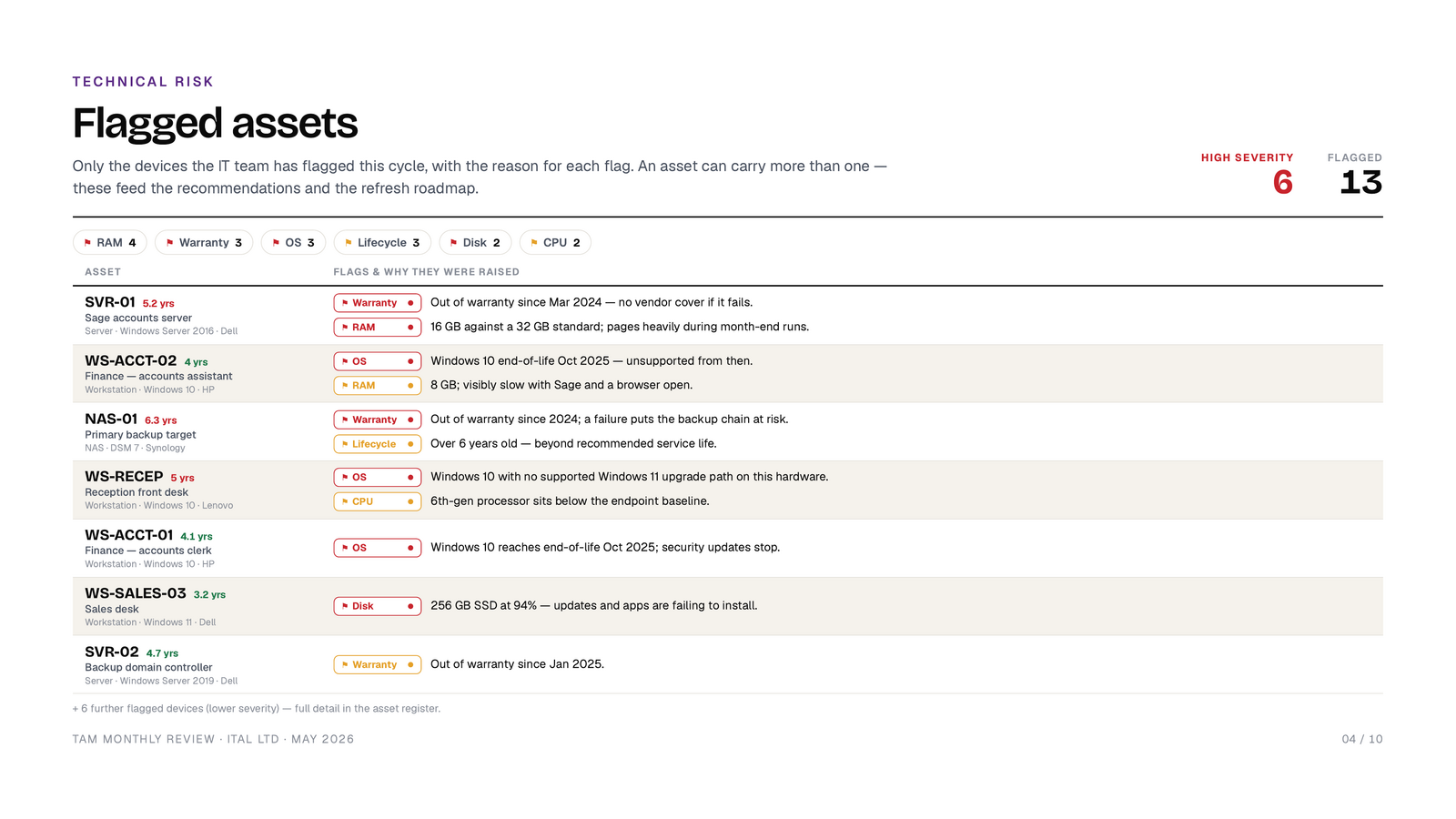
Example output from a demo account, not a real customer's data.
A register that pays for itself in the review
When the register is live and current, every review, monthly or quarterly, opens with a defensible risk position instead of a rebuild-from-memory exercise. Every open risk is a candidate for scoped, budgeted work; every closed one is proof of value delivered.
- Walk into every review with an up-to-date, defensible risk position
- Turn open risks directly into roadmap line items and quoted work
- Show clients a track record of risks identified and closed
- One consistent format across your whole client base
See your own client list scored this way
Book a walkthrough and we'll run the Risk Register against a real (or sample) client so you can see the scoring and roadmap link in action.
Book a demo